


Candidates in final rounds
You have five strong stories. Under pressure you can reach two, and neither is the one they asked for.
Cue reads the question, finds the story in your own CV that answers it, and puts it on screen in your words.
Listens to the question, reads your CV and notes, and puts an answer on screen before the pause gets awkward.
Try CueTell me about a time you had to cut scope on something you cared about.
On my last team I owned the search rewrite. Two weeks out, load testing showed the new ranker adding 400ms at p95. I cut personalised ranking from the launch and shipped the index change alone - 60 percent of the latency win, none of the risk. Personalisation followed six weeks later, measured on its own.
LISTENS WHEREVER YOU TALK
Under pressure, recall is the first thing to go. Not knowledge — recall. The example you needed was in your own CV the whole time.
You have done the work. You just cannot reach it with someone watching.
The question is never phrased the way you rehearsed it.
Nobody can scan a document and hold a conversation at the same time.
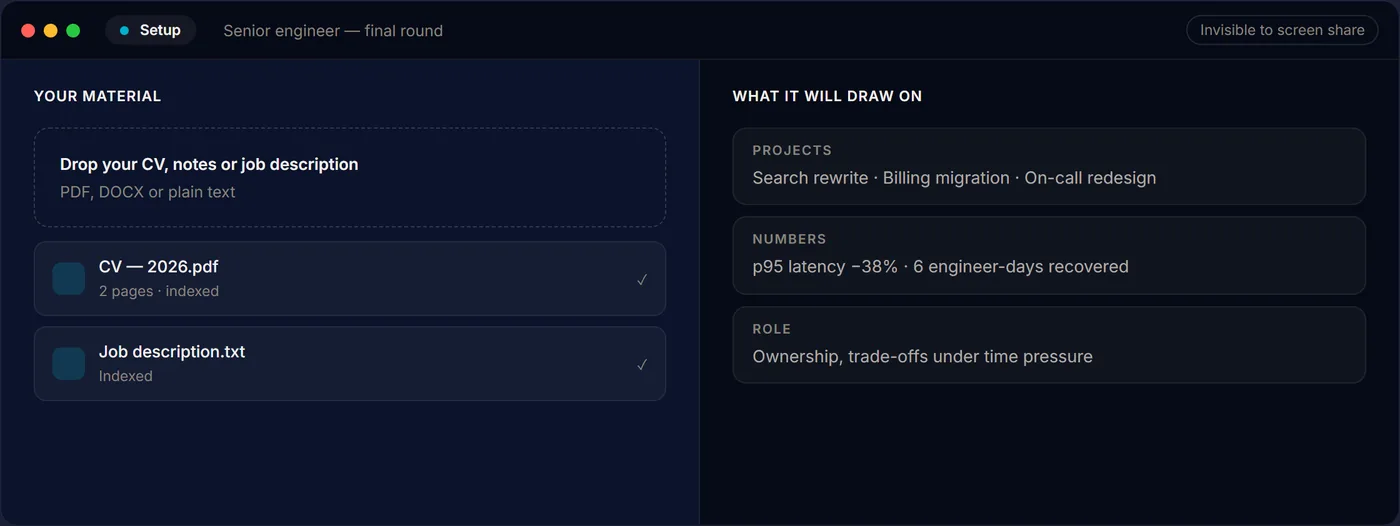
CV, job description, product notes — whatever the conversation will draw on.
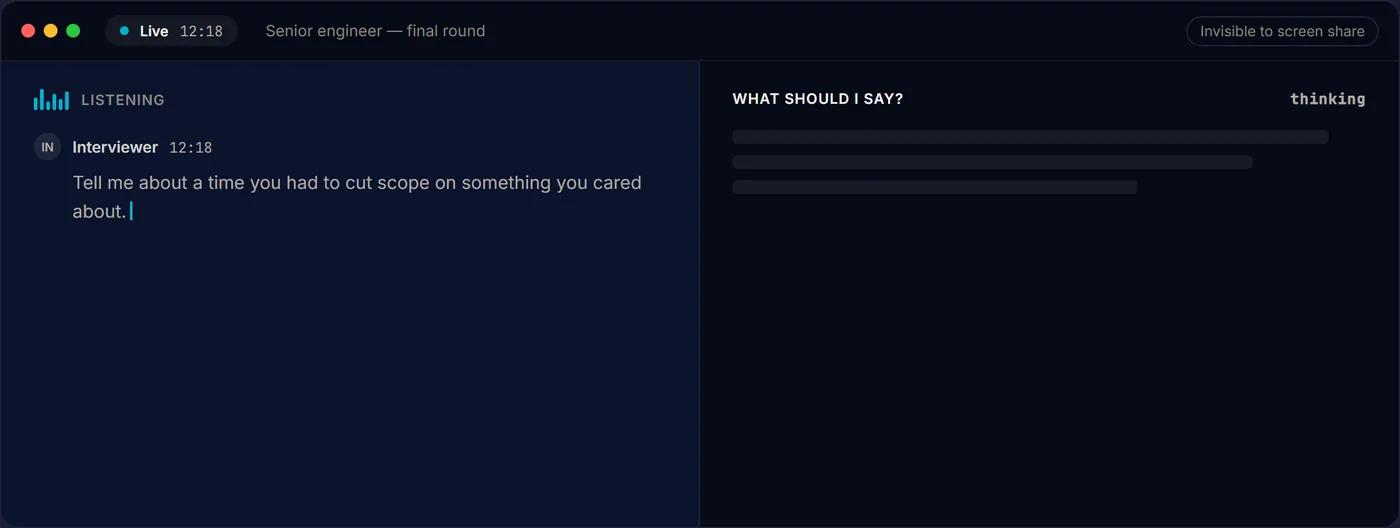
Cue listens alongside you and stays out of the way.
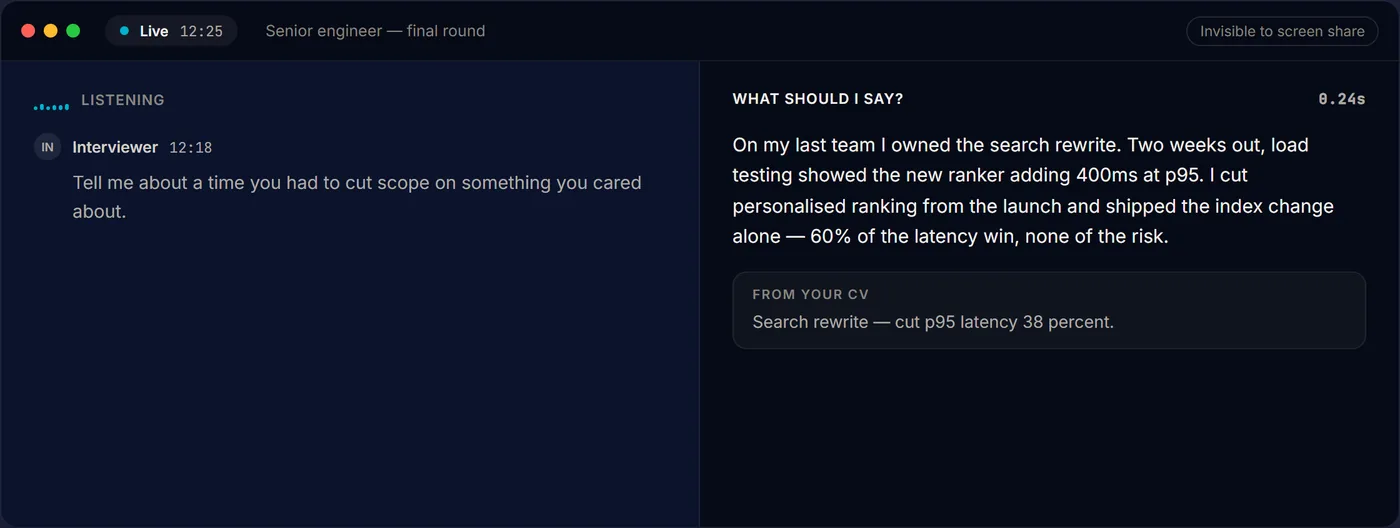
When a question lands, an answer appears in your own material's terms.
You have five strong stories. Under pressure you can reach two, and neither is the one they asked for.
Cue reads the question, finds the story in your own CV that answers it, and puts it on screen in your words.
They ask about the integration you shipped eight months ago and priced differently for two customers.
Your notes are already loaded, so the number and the caveat appear before the pause gets long enough to notice.
You know the answer. Assembling it in English while someone watches you do it is the hard part.
A draft in front of you to speak from, so the gap between what you know and what you can say under pressure stops costing you the room.
You remember the perfect answer in the car.
You say it in the room.
A monthly subscription you use four times a year.
Hours you buy when you need them, that never expire.
Generic advice that fits nobody in particular.
Your CV, your projects, your numbers.
Notes you cannot read mid-sentence.
One screen, already written, while they are still talking.
Cue hears the question, finds the answer in your own CV and notes, and has it on screen in under a second - fast enough to read before the silence is noticeable.
Your CV, your projects, your numbers. The answer is yours rather than generic advice that fits nobody in particular.
Excluded from capture at the OS level, so nobody on the call sees it however you are sharing.
Slower than that and you have already started talking.
Buy time when you need it. No subscription, nothing wasted.
Share a coding problem or a document and ask about what is on it.
Typically under a second from the end of the question — fast enough to read before the silence is noticeable.
That is your call and depends on the setting. It is a tool for recall, the same way notes are; how you use it is up to you.
No. You buy hours, they never expire, and you only spend them while a session is running.
Only what you give it — your uploaded material and the audio of the call, plus your screen if you choose to share it.
Listens to the question, reads your CV and notes, and puts an answer on screen before the pause gets awkward.
Try Cue